
Article: Hamsa Meaning: The Ancient Hand of Protection in Jewelry

Hamsa Meaning: The Ancient Hand of Protection in Jewelry
The short answer: The Hamsa is an ancient hand-shaped symbol used for protection across the Middle East and North Africa for over four thousand years. Its open palm is meant to ward off harm and invite presence, peace, and good fortune. Today the Hamsa appears in everyday jewelry as both a cultural emblem and a personal reminder.
In This Article
- What is the Hamsa?
- Origins and History
- The Hamsa Across Traditions
- Hamsa Hand Facing Up or Down: What the Orientation Means
- The Hamsa and the Evil Eye
- The Hamsa in Modern Jewelry
- Choosing a Hamsa Piece
- Frequently Asked Questions
Few symbols have traveled as far, or meant as much to so many different people, as the Hamsa. The open palm has appeared on amulets, doorways, and jewelry for thousands of years, carried across deserts and seas, picked up and put down and picked up again by cultures that share little else. What unites them is a single quiet idea: that an open hand, held outward, is a gesture of welcome and of warding both. It says, in the same motion, I come without harm and no harm comes to me.
The Hamsa today is one of the most recognizable protection symbols in jewelry. It appears as a pendant, a charm, a signet, a stud. People wear it for the reasons people have always worn it: as a small daily reminder of intention, as a connection to heritage, as a piece of beauty that happens to carry weight. This article looks at where the symbol comes from, how it has been used across cultures, and how it has settled into the contemporary jewelry box.
What is the Hamsa?
The Hamsa, sometimes spelled hamesh, khamsa, or chamsa, is a hand-shaped amulet. The word itself comes from the Semitic root for the number five, a reference to the five fingers of the open hand. In its most common stylized form, the Hamsa has a symmetrical design: a central palm flanked by two thumbs, often decorated with an eye in the center, dots, geometric patterns, or stones. Some versions are anatomically realistic; most are deliberately stylized to set the symbol apart from a literal hand.
The core meaning is consistent wherever it appears: protection. The open palm is held outward to deflect harm, to absorb misfortune before it reaches its wearer, and to invite blessing in its place. In daily life, the Hamsa is worn close to the body, hung in doorways, painted onto walls, or carried as a token. It is not a symbol that requires belief to wear. Many people who carry one today do so because they find it beautiful, because it belongs to their family, or simply because the meaning resonates.
Origins and History
The Hamsa is older than any of the religions it is now associated with. Archaeological evidence places hand-shaped protective amulets in ancient Mesopotamia as early as 1,800 BCE, where they were associated with the goddess Inanna and her counterparts. From there, the symbol traveled west to Carthage, in what is now Tunisia, where it took the form of the Hand of Tanit, a protective emblem of the Phoenician goddess of the same name. Tanit's hand appears on funerary stones and household objects across the ancient Mediterranean, and surviving examples can be found in major museum collections, including the Metropolitan Museum of Art's Heilbrunn Timeline of Art History, which documents Phoenician and ancient Near Eastern protective imagery.
From Carthage, the Hamsa spread along trade routes through North Africa, the Levant, and the Iberian peninsula. By the time the major Abrahamic faiths took shape in the region, the Hamsa was already an old, familiar protective symbol. Each tradition that encountered it adopted it and shaped its meaning to fit, but none invented it. This is part of what makes the Hamsa unusual: it is a symbol that predates the cultures that now claim it, and that has been held in common by communities who agreed on little else.
The Hamsa Across Traditions
The Hamsa appears in several major cultural traditions, each of which has shaped its symbolism over the centuries. The core idea of protection remains constant; the specific associations vary.
In Berber and Amazigh tradition
Long before the Hamsa was adopted by any of the Abrahamic faiths, it was already at home in the cultures of indigenous North Africa. The Berber, or Amazigh, peoples of present-day Morocco, Algeria, Tunisia, and Libya have used hand-shaped amulets for protection for thousands of years. In the Berber language the symbol is sometimes called tafust, meaning "little hand." It appears woven into kilims and textiles, painted onto homes, carved into silver jewelry, and incorporated into tattoo traditions among Amazigh women. When the symbol was later taken up by Jewish and Muslim communities in North Africa, it joined a visual tradition that was already centuries old. The Hamsa is one of the official national symbols of modern Algeria, a reflection of its deep Amazigh roots.
In Jewish tradition
In Jewish culture, the Hamsa is sometimes called the Hand of Miriam, named for the sister of Moses and Aaron. The five fingers are associated with the five books of the Torah and with the Hebrew letter heh, one of the letters in the divine name. The Hamsa has long appeared in Jewish folk art, on ketubahs (marriage contracts), in homes, and in jewelry. It is especially common in Sephardic and Mizrahi communities, where its use traces back through centuries of life in North Africa and the Middle East.
In Islamic tradition
In Islamic culture, the Hamsa is most often called the Hand of Fatima, named for the daughter of the Prophet Muhammad. The five fingers are associated with the Five Pillars of Islam. The Hamsa is widespread across North Africa, particularly in Morocco, Algeria, Tunisia, and Egypt, where it appears on doorways, vehicles, household objects, and personal jewelry. It is one of the most common protective symbols in everyday Maghrebi life, worn and displayed by people across the religious spectrum. The scholarly project Discover Islamic Art, which documents Islamic material culture across museums and collections, catalogs Hand of Fatima objects from across the Muslim world dating back centuries.
In Christian tradition
The Hamsa also appears in some Eastern Mediterranean and North African Christian communities, where it carries the broader regional meaning of protection. In some folk contexts it has been associated with Mary, the mother of Jesus, and is sometimes called the Hand of Mary. Historically, the symbol's use in these communities predates Christianity by thousands of years, and reflects the shared cultural inheritance of the region rather than any single faith tradition. Christian Hamsa jewelry tends to draw on this older, regional symbolism more than on specifically Christian iconography.
Echoes in South and East Asia
The protective open hand is not limited to the Mediterranean and Middle East. Across South and East Asia, the same gesture appears as the Abhaya Mudra, a Sanskrit term meaning "gesture of fearlessness." Found in Hindu, Buddhist, and Jain iconography, the Abhaya Mudra is depicted as a raised right hand with the palm facing outward, the fingers pointing up. It signifies protection, reassurance, and the dispelling of fear. It is older than Buddhism itself, with roots in pre-Buddhist Indian art, and appears across thousands of years of statuary and painting. The Hamsa and the Abhaya Mudra are not the same symbol, and they did not develop from a single shared root. But they share a visual logic and a meaning that suggests something near-universal about the gesture itself: an open palm, held outward, has meant safety and good intent in nearly every culture that has tried to put protection into a shape.
Hamsa Hand Facing Up or Down: What the Orientation Means
One of the most common questions about the Hamsa is which way it should face. The short answer: both are correct, and both are traditional.
A Hamsa facing down, with the fingers pointing toward the ground, is the older and more widespread orientation. It is meant to invite abundance, blessing, and good fortune into the wearer's life, and to keep negativity from passing through. Some traditions associate the downward Hamsa with openness and reception.
A Hamsa facing up, with the fingers pointing toward the sky, is meant to defend against harm. It is read as a stop sign, a refusal, a hand held out against the evil eye and other misfortunes. This orientation became more common over the last few centuries and is now the more frequent design in contemporary jewelry.
Neither orientation is wrong. Many wearers choose based on what feels right, or based on the design they love. Some pieces, like signet rings, render the Hamsa flat without a clear orientation at all.
The Hamsa and the Evil Eye
The Hamsa is closely linked to the Evil Eye, another ancient protective concept found across the Mediterranean, the Middle East, and parts of South Asia. The Evil Eye refers to a kind of harmful look (often born of envy or ill intent) believed to bring misfortune to the person it falls on. Many Hamsa designs include an eye in the center of the palm: a symbolic eye that watches back, deflecting the gaze that would harm.
Hamsa and Evil Eye jewelry are often worn together or in conversation, two related but distinct symbols that protect through different mechanisms. The Hamsa wards through presence and form; the Evil Eye wards through seeing and being seen.
A note on the open hand.
Hamsa, hamesh, khamsa: in three of the world's old languages, the word for this hand is the same word for the number five. Five fingers. Five senses. Five ways to meet the world. The Hamsa does not promise. It witnesses. The hand is not raised in command but held open, palm out, present.
The Hamsa in Modern Jewelry
The Hamsa has moved easily into contemporary jewelry, in part because the symbol itself is so well-designed: bilaterally symmetrical, graphically clear, recognizable at any scale. It works as a tiny stud, a substantial pendant, a flat-engraved signet. At Kate Collins Jewelry, the Hamsa appears in several pieces that approach the symbol differently while drawing on its shared meaning.
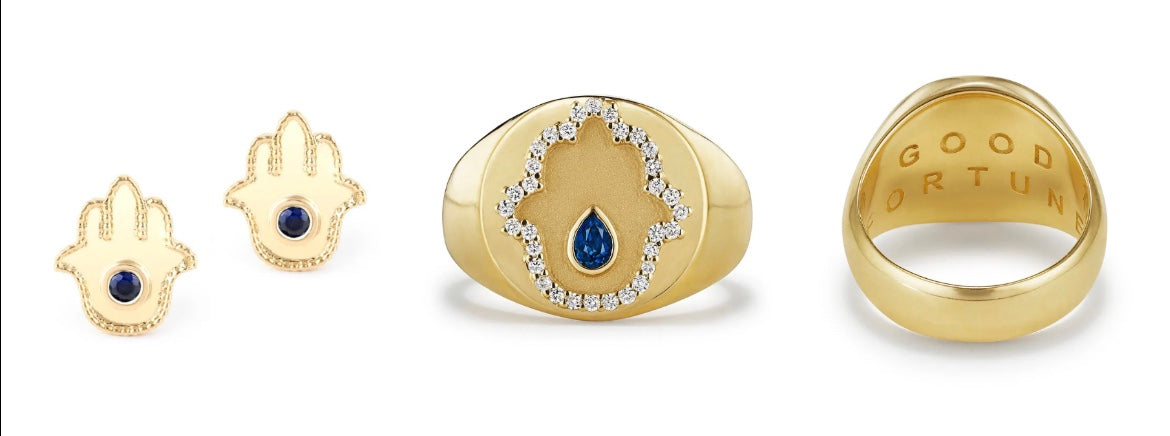
The Good Fortune Hamsa Studs place a small Hamsa close to the wearer, each set with a single sapphire at the center of the palm. The Hamsa Dangler Charm renders the symbol in a delicate dangling form, suited to pairing with the brand's signature huggie hoops. The Diamond and Sapphire Hamsa Signet Ring treats the Hamsa as a sealed emblem on a substantial gold face, framed in diamonds with a teardrop sapphire at its center.
Each piece sits within the brand's broader Protection and Strength collection, alongside other symbols that share the Hamsa's protective lineage.
Choosing a Hamsa Piece
There is no single right way to choose a Hamsa. Some people are drawn to the cultural connection (a piece that links to family, heritage, or tradition). Others are drawn to the meaning itself, choosing a Hamsa as a daily reminder of protection or intention. Others simply love the form. All three are valid reasons, and the Hamsa has historically been worn for all of them.
If you are choosing a Hamsa for the first time, consider how you want to wear it: close to the skin as a stud or pendant, or as a more visible piece like a ring or charm. Consider the orientation that resonates: downward for blessing, upward for warding. And consider the materials. The Hamsa has historically been rendered in gold, silver, and stones believed to amplify its meaning. Sapphire, in particular, has long been associated with protection and clarity, which is why it appears in several of the Hamsa pieces in this collection.
Frequently Asked Questions
What does the Hamsa symbolize?
The Hamsa symbolizes protection from harm. Across cultures, the open hand is meant to deflect misfortune and invite blessing, presence, and good fortune. It is one of the oldest continuously used protective symbols in human history.
What does it mean when the Hamsa hand is facing up versus down?
A downward-facing Hamsa is meant to invite blessing and abundance into the wearer's life. An upward-facing Hamsa is meant to defend against harm and ward off the evil eye. Both orientations are traditional, and both are widely worn.
Is the Hamsa a religious symbol?
The Hamsa predates the major religions that now reference it. It appears in Berber, Jewish, Islamic, and Christian folk traditions, where it carries different specific meanings, but its core meaning of protection is shared. Many people wear it today as a cultural emblem rather than a religious one.
Can anyone wear a Hamsa?
Yes. The Hamsa has been worn across cultures and faiths for thousands of years, and there is no tradition that restricts its use. Many people who wear it have no specific religious affiliation; they wear it for its meaning, its history, or its beauty.
What is the difference between the Hamsa and the Evil Eye?
The Hamsa is a hand-shaped protective symbol. The Evil Eye is a separate but related symbol, usually depicted as a stylized eye, that wards off envious or harmful gazes. The two are often paired in jewelry; many Hamsa designs include an eye in the center of the palm, blending the two protective ideas into one piece.
Continue exploring symbolic jewelry:

Written by Kate Collins