
Article: Protection Symbols: Meaning, History & Jewelry

Protection Symbols: Meaning, History & Jewelry
Protection symbols are visual forms used across cultures and centuries to represent safety, resilience, and the impulse to keep what matters intact. They appear on amulets, doorways, and jewelry, often where words feel insufficient. The shapes change. The intention behind them does not.
At Kate Collins Jewelry, we approach these symbols the way they have always been approached: as quiet companions, worn close, carried daily. This guide explores what protection symbols mean, where they come from, and how they translate into jewelry that holds intention without announcing it.
What Are Protection Symbols?
Protection symbols are visual representations of the wish to be kept safe. They distill an abstract feeling into a form that can be drawn, carved, worn, or hung above a doorway. Some are tied to specific religious or cultural traditions. Others have moved between traditions for so long that their origins blur.
What unites them is function. A protection symbol gives shape to vigilance, to care, to the desire that another person, or oneself, remain unharmed. As Britannica notes, symbolic expression is one of the oldest and most consistent modes through which cultures have conveyed beliefs and intentions. Protection is among the earliest of those intentions.
In jewelry, these symbols become wearable. They sit close to the skin, marking intention without requiring explanation. The wearer knows. That, historically, has been enough.
Why Humans Have Used Symbols for Protection Across Cultures

The instinct to protect is older than written language. Long before formal religion, people drew shapes onto cave walls, stones, and tools to ward off what they could not see or control. Archaeological collections at The British Museum document protective amulets from Egypt, Mesopotamia, and the Mediterranean basin dating back thousands of years.
What emerged was a shared human pattern. Across geographies that had no contact with one another, similar ideas appeared: the eye that watches back, the open hand that deflects, the knot that cannot be untied. The repetition is not coincidence. It reflects something consistent about how humans understand vulnerability and the desire to meet it with form.
Protection symbols persist today for the same reason they began. They give the abstract a shape. They make the wish to be kept safe something a person can hold.
10 Protection Symbols and Their Meanings
The following symbols appear across the broadest range of cultures and remain in active use, including in modern jewelry. Each carries its own history, its own visual logic, and its own way of expressing the same underlying intention.
1. Hamsa (Hand of Fatima)

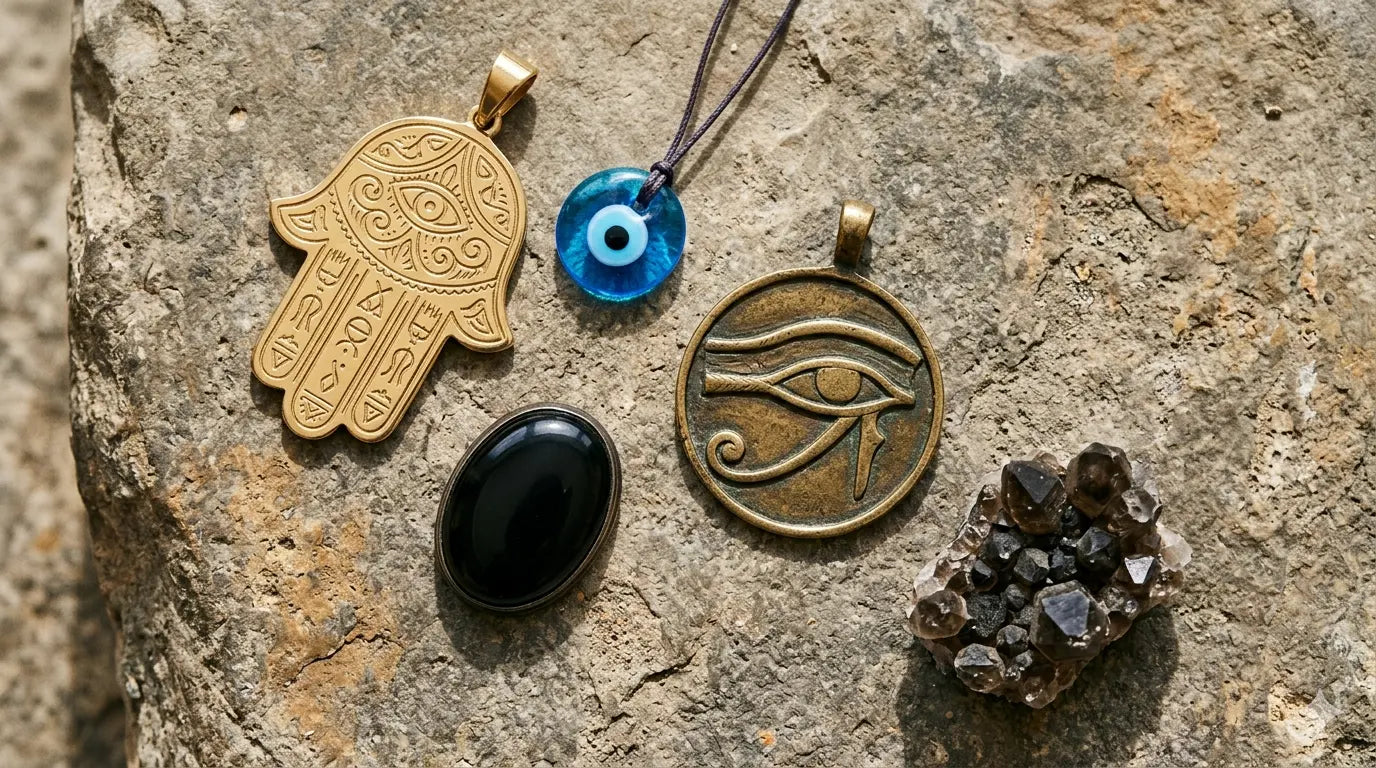
The Hamsa is an open right hand, often depicted with an eye at its center. It originates in the ancient Middle East and appears across Jewish, Islamic, and Christian traditions. In Arabic, hamsa means five, referring to the five fingers of the hand. In Jewish tradition it is sometimes called the Hand of Miriam; in Islamic tradition, the Hand of Fatima.
The Hamsa is associated with protection from the evil eye, with blessing, and with openness to positive energy. It is considered a symbol that both deflects harm and invites good. In jewelry, the Hamsa is often paired with gemstones or a central eye motif, reinforcing its protective role. It pairs naturally with everyday wear and is one of the most enduring protection symbols across cultures. Browse Hamsa and other protection pieces for examples in fine gold.
2. Evil Eye (Nazar)
The Evil Eye, or nazar, is a symbol that protects against the malicious gaze of others. It typically appears as a concentric circle in shades of blue and white, resembling an eye looking outward. Its origins trace back to ancient Greece and Mesopotamia, with continuous use across the Mediterranean, Middle East, and South Asia for at least three thousand years.
The symbol works by reflection. Wearing or displaying an evil eye is believed to redirect harmful intention back toward its source. It is one of the most widely recognized protection symbols in the world, worn by people who do not necessarily share the same culture or beliefs. In jewelry, the evil eye appears in pendants, signet rings, and charms, often set with gemstones that echo its traditional blue. Kate Collins Jewelry's Protection Evil Eye Signet Ring is one expression of this enduring form.
3. Eye of Horus
The Eye of Horus, or wedjat, is an ancient Egyptian symbol representing protection, royal power, and good health. It depicts a stylized human eye with markings drawn from the falcon, the bird associated with the god Horus. According to The Metropolitan Museum of Art's Egyptian collection, wedjat amulets were worn by both the living and placed with the dead for over two thousand years.
The symbol's meaning combines watchfulness with restoration. In Egyptian mythology, the eye was lost and restored, becoming a symbol of healing as well as protection. The Eye of Horus and the Evil Eye are sometimes confused, but they function differently. The Evil Eye deflects; the Eye of Horus watches and restores.
4. Cross
The cross is among the most recognized protection symbols in the world. While its primary association is Christian, the cross as a protective form predates Christianity by thousands of years, appearing in ancient Egyptian, Celtic, and pre-Columbian American traditions in varied forms.
In Christian tradition, the cross represents the crucifixion of Christ and, by extension, divine protection, salvation, and the presence of the sacred in daily life. Worn as jewelry, the cross is often chosen as a quiet expression of faith or as a connection to family and tradition. Kate Collins offers cross pieces designed to honor that intention with restraint, including cross designs in the Protection & Strength collection.
5. Pentagram
The pentagram is a five-pointed star drawn in a single continuous line. Its protective use predates its modern associations. Ancient Babylonian, Greek, and early Christian sources all used the pentagram as a symbol of wholeness, balance, and protection. The five points have been variously interpreted as the five elements, the five wounds of Christ, or the five senses.
In modern Wiccan and pagan traditions, the pentagram, especially when enclosed in a circle, is a primary protection symbol, representing harmony among the elements and the practitioner's grounding in them. Worn upright, it is widely understood as protective. The pentagram sits within a long lineage of geometric protection symbols that use closed forms to suggest completeness.
6. Triquetra (Trinity Knot)
The Triquetra, or Trinity Knot, is a Celtic symbol formed by three interlaced arcs creating a continuous loop. Its origins are pre-Christian, appearing on stone carvings and metalwork across the Celtic world. After the spread of Christianity through Ireland and Scotland, the symbol was adopted to represent the Holy Trinity, though its protective associations are older.
The Triquetra's protective meaning rests in its continuity. The knot has no beginning and no end, suggesting eternity, unbroken connection, and the resilience of bonds that cannot be severed. It is one of several Celtic knot forms used historically as protective amulets. In jewelry, its clean geometric form translates well into gold and silver work.
7. Ankh
The Ankh is an ancient Egyptian symbol shaped like a cross with a looped top. It represents life, and by extension, the protection of life. In Egyptian iconography, gods are frequently depicted holding the Ankh to the noses of pharaohs and the deceased, conferring breath, vitality, and continued existence.
The Ankh's protective dimension is inseparable from its association with life force. To wear the Ankh is to invoke the wish for continued life, health, and presence. The Gemological Institute of America notes that ancient Egyptian amulets, including the Ankh, were often crafted in gold and lapis lazuli for their associations with the divine and the eternal. Modern jewelry continues that tradition in form, if not always in materials.
8. Algiz Rune
Algiz is a rune from the Elder Futhark, the oldest runic alphabet used by Germanic peoples from roughly the second through eighth centuries. The rune is shaped like a Y or a tree with upraised branches, and its primary meaning is protection. It is sometimes interpreted as an upraised hand warding off harm, or as an elk's antlers signaling defense.
Among Norse runic symbols, Algiz is the most direct expression of protection. It was carved onto weapons, doorways, and personal objects as a protective sigil. Its visual simplicity has made it durable across centuries. In contemporary jewelry, Algiz appears in pieces designed for those drawn to Norse tradition or to the rune's clean, vertical form.
9. Helm of Awe (Aegishjalmur)
The Helm of Awe, or Aegishjalmur, is an Icelandic protective sigil composed of eight tridents radiating from a central point. It appears in medieval Icelandic grimoires and is associated with both protection and the projection of strength outward. Its visual structure, with its eightfold symmetry, suggests defense from all directions.
Historically, the Helm of Awe was said to be drawn on the forehead before battle. Its meaning combines protection with presence: the wearer is protected, and is also visibly difficult to approach. As a jewelry motif, it is rare but enduring, chosen by those drawn to its geometric weight and its history.
10. Ouroboros
The Ouroboros is a serpent or dragon depicted swallowing its own tail, forming a continuous circle. The symbol appears in ancient Egyptian, Greek, Norse, and alchemical traditions, often representing eternity, cyclical renewal, and the unity of opposites. Its protective meaning derives from its closed form: a sealed circle that cannot be entered.
In jewelry, the Ouroboros appears as rings, pendants, and bracelets, often executed with fine detail in the serpent's scales and head. It carries protective and transformative meaning simultaneously, suggesting both the keeping safe of what is whole and the renewal that follows when something completes itself.
Protection Symbols by Tradition
Beyond the symbols above, many cultures developed their own distinct protective vocabularies. The following traditions each contributed forms that remain in use, some adopted internationally, others still primarily known within their cultures of origin.
Celtic Protection Symbols
Celtic tradition produced an extensive vocabulary of protective knotwork, drawing on the idea that an unbroken line cannot be entered. Beyond the Triquetra, the Shield Knot, with its four corners suggesting the cardinal directions, was used historically as a protective form on amulets and in stone carvings. The Dara Knot, named for the oak (doire), represents inner strength and the rooted resilience of the oak tree. Together, these symbols reflect a tradition that understood protection as both warding off harm and cultivating internal stability.
Norse Protection Symbols
Norse protective symbolism centers on runes and sigils used in both daily life and ritual. The Algiz rune, the Helm of Awe, and the Vegvisir, sometimes called the Norse compass, all served protective functions. Vegvisir, a circular sigil with eight staves, was believed to help the bearer find their way through difficult conditions, a form of protection that emphasizes orientation rather than warding. Norse protection symbols share a visual character: bold, symmetrical, and emphatic.
Egyptian Protection Symbols
Ancient Egypt developed one of the most elaborate protection vocabularies in the ancient world. The Eye of Horus and the Ankh, covered above, were joined by the Scarab beetle, associated with regeneration and protection in the afterlife, and the Wedjat eye, a closely related variant of the Eye of Horus. The Smithsonian's collection includes Egyptian amulets in faience, gold, and lapis, attesting to the centrality of protection symbolism in daily and funerary life. Lapis lazuli in particular was associated with the protective power of the heavens.
Christian Protection Symbols
Christian protection symbolism centers on the Cross but extends to the Crucifix, the Saint Christopher medal traditionally worn by travelers, and the Miraculous Medal associated with Marian devotion. Each carries a distinct emphasis. The Cross signals general protection and faith. The Crucifix emphasizes the specific protection of Christ's sacrifice. The Saint Christopher medal addresses safe passage, particularly during travel. These symbols remain among the most widely worn protection symbols globally.
Witchcraft and Pagan Protection Symbols
Modern witchcraft and pagan traditions draw on a wide range of protective symbols, often weaving together older sources. The Pentagram, covered above, is the most widely recognized. Beyond it, the Triple Moon, representing the maiden, mother, and crone, is associated with feminine protection across stages of life. Bind runes, formed by combining multiple runes into a single sigil, are used to layer protective intentions. These symbols are typically chosen for personal practice rather than public display.
Japanese Protection Symbols
Japanese protective objects often function as physical talismans rather than abstract symbols. The Omamori, a small embroidered pouch obtained from Shinto shrines and Buddhist temples, contains a written prayer or invocation and is carried for protection. The Maneki-neko, the beckoning cat, invites good fortune and wards off misfortune. The Daruma doll, modeled on the Buddhist monk Bodhidharma, is associated with perseverance and the protection of intention through difficulty. These objects share an emphasis on protection through practice and presence rather than decoration alone.
Protection Stones in Jewelry
Symbols are one half of how protection is expressed in jewelry. Stones are the other. Certain gemstones have been associated with protection across cultures for as long as protection symbolism has existed, and their presence in fine jewelry continues that tradition.

Black Onyx is one of the most consistent protective stones, associated with grounding, strength, and the deflection of negativity. Its deep black surface has carried protective meaning from Roman signet rings through Victorian mourning jewelry and into contemporary fine jewelry. For the full history, read our Black Onyx Meaning guide, or browse Black Onyx jewelry.
Other stones associated with protection include turquoise, long worn as a protective amulet across the American Southwest and the Middle East; obsidian, used historically for its perceived ability to absorb negative energy; and lapis lazuli, prized in ancient Egypt for its association with the protective heavens. Each carries a distinct character, but all share the role stones have played for millennia: making protection something held, not just imagined.
How to Choose Protection Jewelry
Choosing protection jewelry is less about rules than about recognition. The right piece often reflects what feels relevant in your life at a specific moment. Some people are drawn to a particular symbol immediately. Others come to one slowly, through repeated exposure or through a piece given by someone who saw something in them.
A few considerations may be useful. First, consider whether you are drawn more to a symbol or to a stone. Both carry protective meaning, but the emphasis is different. A symbol points outward, naming a specific tradition or intention. A stone tends to work more quietly, anchoring the piece in material rather than form. Many of the strongest pieces combine both.
Second, consider how the piece will live with you. Protection jewelry was historically meant to be worn daily, not reserved for special occasions. Pieces designed for everyday wear, in materials that will last, tend to be the ones that take on protective meaning over time. KCJ's Protection & Strength collection is built around that principle: pieces in solid gold, designed to be worn and to accumulate meaning through use.
Finally, trust the recognition when it happens. Protection symbols have endured for thousands of years because they speak to something humans return to. The piece that feels right is rarely the result of analysis. It is more often the result of paying attention.
Frequently Asked Questions
What is the most powerful protection symbol?
There is no single most powerful protection symbol. Different cultures and traditions emphasize different forms: the Hamsa in the Middle East, the Eye of Horus in ancient Egypt, the Cross in Christian traditions, the Algiz rune in Norse practice. The strength of a protection symbol depends in large part on the wearer's connection to its tradition and meaning. Among the most widely worn globally are the Hamsa, the Evil Eye, and the Cross.
Can I wear protection symbols from a culture that is not mine?
Many protection symbols, including the Evil Eye, the Hamsa, and the Cross, have moved across cultures for centuries and are widely worn outside their cultures of origin. Others, such as Native American protective symbols or sacred Indigenous forms, are tied to living traditions and are typically not worn outside them. A general guide: symbols with long histories of cross-cultural adoption are generally worn freely; symbols still central to closed religious or cultural practices warrant more care.
What is the difference between protection symbols and protection jewelry?
Protection symbols are the visual forms themselves, used in any medium, from amulets to architecture. Protection jewelry refers specifically to jewelry that incorporates these symbols or uses materials, such as black onyx or turquoise, with protective associations. Protection jewelry is one of the most enduring vehicles for protection symbolism because it stays close to the body and is worn daily.
Which gemstones are associated with protection?
Black onyx is among the most consistent protective stones across cultures, associated with grounding and strength. Turquoise, obsidian, lapis lazuli, and hematite also carry protective associations. The Gemological Institute of America provides foundational information on these stones' physical properties; their symbolic meanings have been shaped over centuries of cultural use.
How should I choose a protection symbol that is right for me?
Begin with the meaning that feels most relevant. If you are drawn to specific cultural or religious traditions, symbols rooted in those traditions often resonate most. If you are drawn more to general protective intention, broadly worn symbols such as the Evil Eye or Hamsa offer a starting point. Pay attention to which symbols you return to. Recognition often precedes explanation.
Can protection jewelry be worn every day?
Yes, and historically it was meant to be. Protection jewelry was designed for daily wear, and pieces in durable materials such as solid gold are built for that purpose. Daily wear is part of how protection jewelry takes on meaning over time, becoming associated with the wearer's life rather than separate from it.
Wear Protection With Intention
Protection symbols endure because the wish behind them does. They translate something that resists language, the desire to keep what matters intact, into forms that can be worn, held, and passed on. In jewelry, that translation becomes personal. The symbol is no longer abstract. It is yours.
Explore the Protection & Strength collection for pieces designed around that intention, or browse Black Onyx jewelry for the protective stone with the longest continuous history in fine jewelry. For broader context on how symbolic jewelry carries meaning across categories, our Symbolic Jewelry Guide offers a starting point.

Written by Kate Collins